 Save to Pinterest
 My first okonomiyaki came from a tiny stall wedged between a convenience store and a pachinko parlor in Osaka, where an elderly woman flipped pancakes with the precision of someone who'd done it ten thousand times. I watched, mesmerized, as she layered cabbage into batter, pressed it flat, and somehow transformed it into something both crispy and tender that made me understand why this humble street food had survived generations. When I finally tried making it at home, I realized the magic wasn't complicated at all—it was just paying attention to the sizzle, trusting the flip, and not overthinking the toppings.
I made these for a dinner party last spring when a friend visiting from Tokyo mentioned she was craving home food, and watching her face light up as she took that first bite—sauce dripping down her chin, laughing at how messy it was supposed to be—reminded me that the best recipes are the ones that bridge distance and memory. She stayed an extra hour just sitting at the counter, helping me flip the next batch and telling stories about eating okonomiyaki at festivals with her grandfather.
Ingredients
- All-purpose flour: The foundation that gives structure without heaviness; I learned that sifting it together with baking powder prevents lumps that ruin the tender crumb.
- Dashi stock: This is what separates homemade from forgettable—the subtle umami depth it brings is irreplaceable, though good water works in a pinch.
- Eggs: Use room temperature for the smoothest batter, and whisk them thoroughly so they're fully incorporated.
- Finely shredded green cabbage: The texture matters here; use a mandoline or very sharp knife so the pieces are thin enough to cook through without getting mushy.
- Green onions and carrot: These provide brightness and a gentle crunch that contrasts beautifully with the soft cabbage.
- Bean sprouts: Optional but they add a delicate texture and fresh note that feels almost luxurious when you bite into them.
- Bacon or pork belly: Press these into the batter so they cook into the pancake rather than sitting on top; it distributes the flavor throughout.
- Cooked shrimp: Chop them small so every bite has a hint of sea without overwhelming the other flavors.
- Okonomiyaki sauce: If you can't find it, the Worcestershire-ketchup-soy mixture works, but true okonomiyaki sauce has a subtly sweet depth that elevates everything.
- Japanese mayonnaise: Richer and tangier than American mayo, it's worth seeking out because the difference is genuinely noticeable.
- Bonito flakes: Buy them fresh if possible; the thinner, more delicate ones seem to dance more beautifully when the heat hits them.
- Aonori and pickled ginger: These are the final flourish that prevent the dish from feeling heavy, adding bright, sharp notes that wake up your palate.
Tired of Takeout? 🥡
Get 10 meals you can make faster than delivery arrives. Seriously.
One email. No spam. Unsubscribe anytime.
Instructions
- Mix your base:
- Whisk flour, dashi, eggs, salt, and baking powder together until you have a smooth batter with no lumps hiding in the corners. This is worth taking thirty seconds extra on because lumps will show themselves when you cook.
- Fold in the vegetables:
- Gently fold the shredded cabbage, green onions, carrot, and bean sprouts into the batter until everything is evenly coated; you're not trying to break the cabbage down, just distribute it evenly. If using shrimp, fold that in now as well.
- Heat your cooking surface:
- Set a large nonstick skillet or griddle over medium heat and let it warm for a minute, then very lightly oil it—too much oil and the pancake slides around and never develops a proper crust. You want just enough so it doesn't stick.
- Pour and shape:
- Pour about a quarter of the batter onto the skillet and gently shape it into a round pancake about half an inch thick using the back of a spatula or spoon. Don't press too hard or you'll squeeze out all the moisture.
- Add your protein:
- If using bacon or pork belly, lay the halved pieces across the top now, pressing them gently into the batter so they're anchored. They'll fuse into the pancake as it cooks.
- Cook the first side:
- Let it sit undisturbed for four to five minutes until the bottom develops a golden-brown crust that releases easily when you slide a spatula underneath. The edges will look set before the center feels ready, so wait for the bottom to have real color before flipping.
- The flip:
- This is the moment that feels dramatic—slide the spatula underneath, take a breath, and flip it decisively in one confident motion. If it sticks, give it another thirty seconds.
- Cook the second side:
- Cook for another four to five minutes until the second side is equally golden and the pancake feels firm when you press it gently with the spatula. You want both sides to have that beautiful caramelized color.
- Finish with toppings:
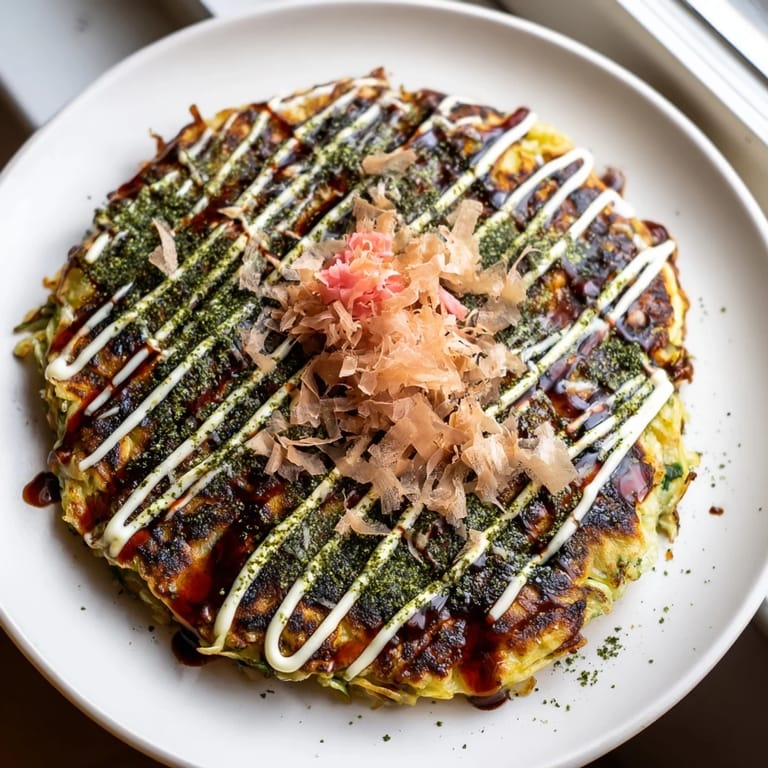
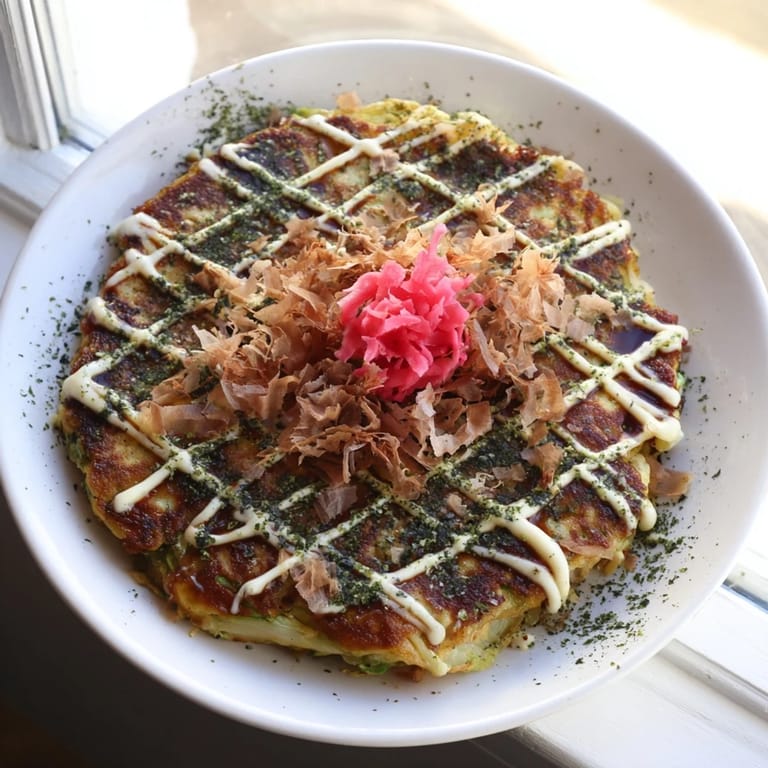
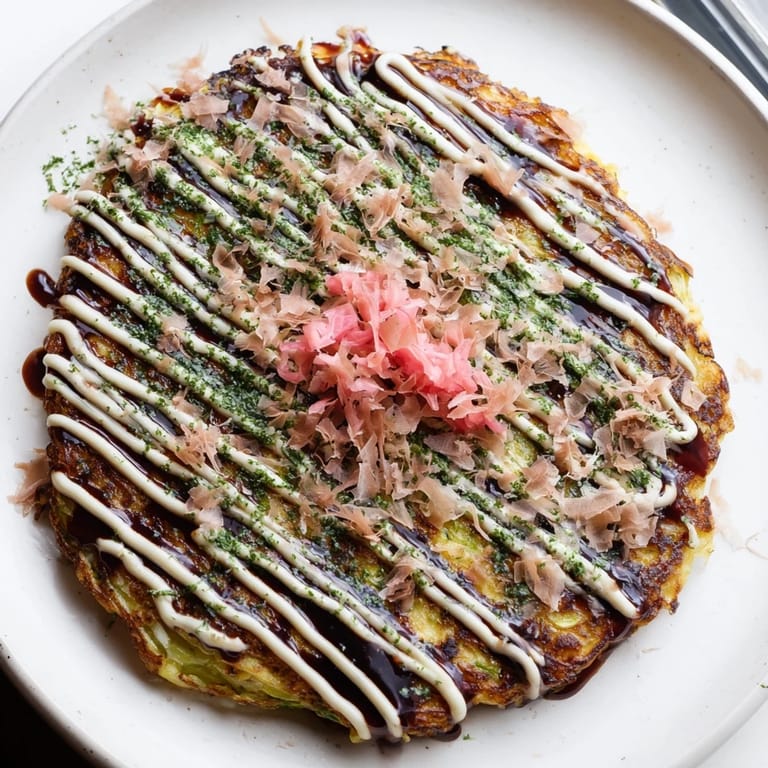
- Transfer each pancake to a plate and immediately drizzle the okonomiyaki sauce and mayonnaise in a crisscross pattern while it's still hot. The warmth helps the sauces flow and meld slightly into the surface.
- Final garnish:
- Sprinkle bonito flakes, aonori, and pickled ginger generously over the top, and watch the bonito flakes begin to curl from the residual heat. Serve immediately so everything is still warm.
 Save to Pinterest
 These pancakes taught me something about cooking that I think about often: sometimes the most memorable meals come from the simplest things, especially when they're made with a little attention and served with genuine care. There's something about the combination of textures and flavors—the crispy exterior, soft interior, tangy sauce, creamy mayo, and those magical curling bonito flakes—that makes people slow down and actually taste their food.
Building Your Own Variations
Once you've mastered the basic technique, okonomiyaki becomes wonderfully flexible in a way that encourages you to experiment. I've added corn kernels for sweetness, scattered cheese for richness, and even mixed in sliced mushrooms for earthiness—each variation shifts the flavor profile without requiring you to change your technique. The batter is forgiving enough that you can play with it, and that playfulness is part of what makes cooking these so satisfying.
Pairing and Serving
The best way to serve okonomiyaki is hot and immediately, as a casual meal where people gather around the kitchen counter rather than sitting formally at a table. A cold glass of sake or a light Japanese beer alongside it somehow makes the sauces taste brighter and the whole experience feel more celebratory. I've also learned that okonomiyaki is remarkably good as a late-night snack when you make it for yourself, standing at the stove in your kitchen, eating straight from the pan with a wooden spatula.
Storage and Make-Ahead Tips
If you have leftovers—though you probably won't—you can refrigerate them in an airtight container for up to three days and reheat them briefly in a dry skillet to restore some of the crispness. The batter can be mixed a few hours ahead and refrigerated, though it's best cooked within a couple of hours of mixing so the baking powder stays active. Here's what I've discovered works beautifully through repetition and small mistakes:
- Prep all your vegetables and proteins before you start cooking so you're not rushing around with a hot pan waiting for you.
- Room-temperature ingredients blend more smoothly than cold ones, and a warmer batter spreads more easily on the hot skillet.
- If the first pancake seems to stick or spread unevenly, don't panic—you're just calibrating the heat and oil level, and the second one will be perfect.
 Save to Pinterest
 Making okonomiyaki is one of those cooking experiences that gets better every time you do it, partly because the technique becomes more natural and partly because you figure out exactly how you like it. There's something quietly satisfying about standing at a hot skillet, flipping pancakes, and knowing that in just a few minutes, you're going to create something delicious that will bring people together.
Recipe FAQs
- → What is okonomiyaki sauce?
Okonomiyaki sauce is a thick, tangy-sweet Japanese condiment similar to Worcestershire sauce mixed with ketchup. You can buy it pre-made at Asian markets or create a substitute using Worcestershire, ketchup, and soy sauce in equal parts.
- → Can I make okonomiyaki vegetarian?
Absolutely. Simply omit the bacon, pork belly, and shrimp from the batter. The cabbage and vegetable fillings provide plenty of substance and flavor. Ensure your okonomiyaki sauce and mayonnaise are vegetarian-certified.
- → What are bonito flakes and why do they move?
Bonito flakes (katsuobushi) are thin, dried shavings of skipjack tuna. They curl and appear to dance on hot okonomiyaki due to steam rising from the freshly cooked pancake. This visual effect is part of the dish's charm and adds a smoky, umami flavor.
- → How do I flip okonomiyaki without breaking it?
Use a wide, sturdy spatula and flip quickly and decisively in one confident motion. The pancake should be set enough after 4-5 minutes on the first side. If it feels fragile, cook it slightly longer before attempting to flip.
- → Can I add other ingredients to the batter?
Yes, okonomiyaki is very customizable. Try adding corn kernels, melted cheese, mushrooms, or different vegetables. Keep the total vegetable volume around 3-4 cups and adjust liquid if needed to maintain a pourable batter consistency.
- → What's the difference between okonomiyaki and takoyaki?
Okonomiyaki are flat, pan-fried savory pancakes with cabbage as the star ingredient. Takoyaki are round, deep-fried batter balls filled with octopus. Both are Japanese street foods but made with different cooking methods and primary ingredients.